



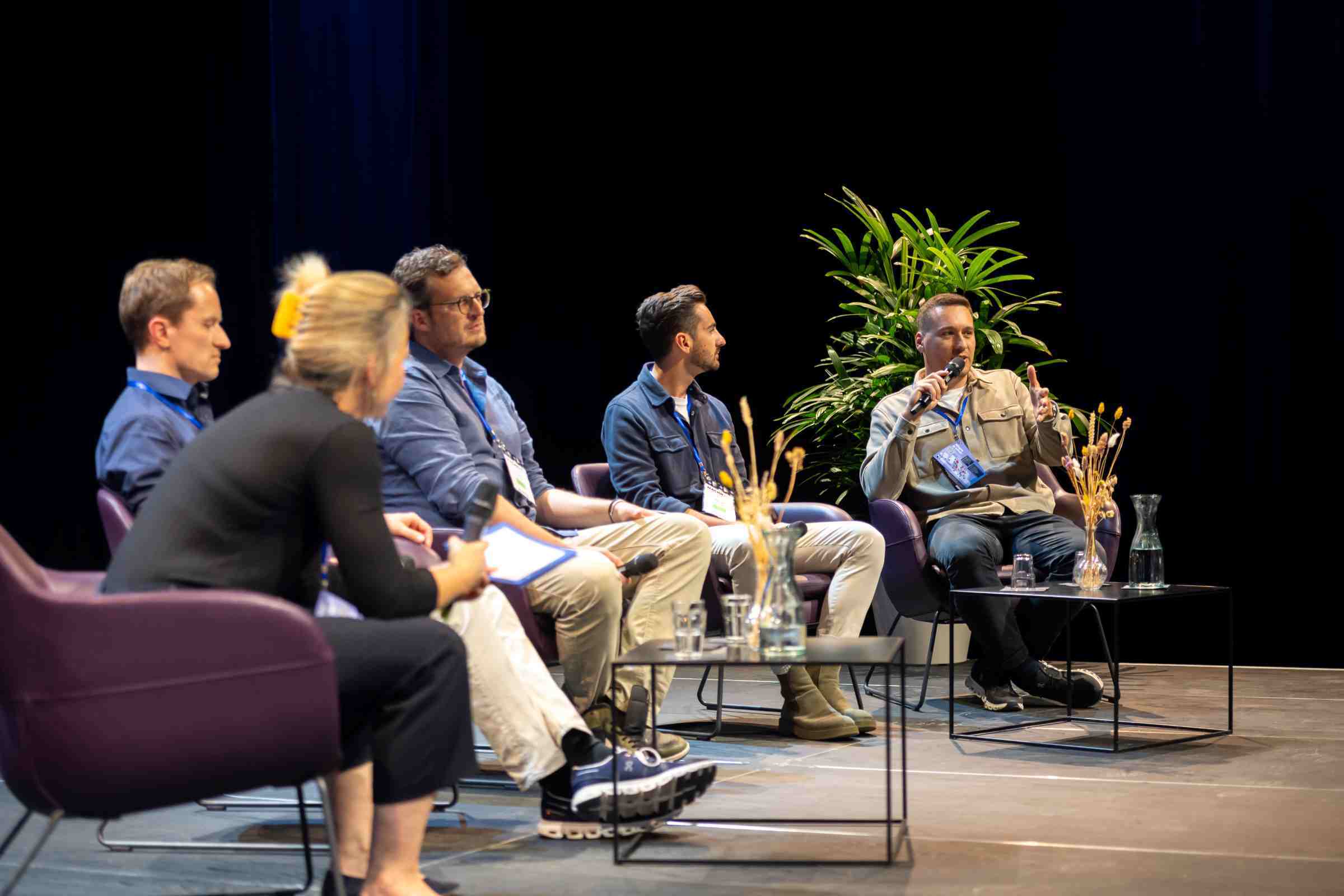
Following a deep dive into the blueprint of "EU Inc," the conversation at the SpinLab Investor Day shifted directly to the frontlines of venture capital. Moderated by Noah Lorenz – founder of the successful SpinLab startup mementor and now a venture partner at SIVentures – a panel of European VC investors gathered to share their challenges with the continent's fragmented legal system.
The panel brought together diverse perspectives: Vaclav Vincent Pavlecka (United Founders, Prague), Ion Hauer (APEX Ventures), Ole Peters (BD Partners, Prague), and Wojciech Ratymirski (Radix Ventures, Poland). Together, they painted a vivid picture of why Europe’s 27 separate legal frameworks make scaling a business unnecessarily complicated and how the industry can help itself while waiting for political reforms.
The True Pain of Scaling Up
The panel quickly agreed: starting a company in Europe is no longer the problem. At least in countries like Estonia, where it takes three hours or Poland, where it takes 24 hours to launch a pre-seed company. The real hustle begins the moment a business succeeds and begins to scale. That's when European startups often decide to abandon their European roots and relocate to the US, where the regulatory framework is much more favourable for operating as a Delaware Corporation.
For startups working in complex fields like Deep Tech, local capital is rarely enough. Wojciech Ratymirski, whose fund Radix Ventures deploys capital across Central and Eastern Europe, explained that Deep Tech companies cannot survive without a proper Series B round. To raise that kind of money, founders must build a coalition of investors from several different countries. In Europe's current landscape, this triggers massive legal hustle where every document has to be completely "re-papered" and rewritten to fit multiple jurisdictions.
Ion Hauer pointed out that operational friction across borders is an everyday tax on growth, particularly when hiring talent.
-
The Remote Work Trap: Startups naturally want to hire the best engineers across Europe, but managing crossborder laws is so complicated that an entire industry of expensive service providers has emerged just to handle the paperwork.
-
Losing Partnerships over Paperwork: Vaclav Vincent Pavlecka shared a personal example of trying to build a truly pan-European venture fund with partners in Germany and the UK. The legal hurdles and "passporting" bureaucracy were so severe that the partnership dissolved before they could even get the legal structure working under one framework.
Challenge of Financing Beyond Borders
Ole Peters noted that this complexity creates an artificial barrier between neighboring regions. While Western European investors should be highly active in emerging, talent-rich markets like Prague and Central Eastern Europe, the friction of learning a foreign country's legal system acts as a massive psychological and financial blocker. An "EU Inc" structure would instantly make premature ecosystems more attractive to international capital.
The ESOP Nightmare
Another critical piece of the puzzle is the Employee Stock Option Plan (ESOP). In the United States, equity is a standard tool used to attract world-class talent Pavlecka emphasized that the golden rule for employee equity must be "no tax before cash." In many European countries, the moment an employee receives stock options, the tax authority knocks on their door demanding a percentage of value that hasn't even been realized yet.
Furthermore, because regulations are so strict, startups in countries like Poland have to invent workarounds just to give their engineers equity. Without an easy, standardized way to share ownership, Europe struggles to create the "flywheel effect" seen in Silicon Valley, where early employees at companies like Nvidia become millionaires and go on to fund or build the next generation of tech giants, mentioned Ion Hauer.
Trust vs. Over-Complication: A Call for Self-Regulation
While the investors are hopeful about the future of EU Inc, they have emphasised on several occasions that the key issue is its proper implementation. They recognize that politicians don't like to lose control and may still add heavy regulations at the state level. Because of this, the panel urged the European venture ecosystem to take a look in the mirror and stop complicating things themselves.
Ratymirski noted that standard investor agreements are often over-drafted by lawyers, taking months to negotiate, even though there is rarely anything left to distribute if a company fails. He pointed to the US system, where standardized, open-source legal documents allow multi-million dollar deals to close instantly.
Hauer suggested a practical shortcut: if major, mature markets such as Germany, the UK and France were to officially adopt a unified set of standardised transaction templates, this would instantly become the European default.
Facing Failure with a Healthy Mindset
The panelists agreed that a healthier relationship with failure is missing from European business culture. In a high-trust startup ecosystem, an investor monitors the business closely. If it goes south despite the founder's best efforts, the relationship should allow them to cleanly dissolve the company and move on.
As the panel wrapped up, Noah Lorenz asked the group for a final wish to send to the lawmakers currently designing the EU Inc framework in Brussels. The collective answer was: "Be hopeful, and don't give too much control to local state registries."
To capture that optimism, the panelists took a group picture on stage, promising to meet again in five years to see just how far European tech has come.
More about the status quo of the EU Inc can be read here.

/RootCamp_Logo-Ecosystem.png?width=200&name=RootCamp_Logo-Ecosystem.png)

/Bitroad_Logo-Ecosystem.png?width=200&name=Bitroad_Logo-Ecosystem.png)




/White%20Versions/stadt_leipzig_white.png?width=130&name=stadt_leipzig_white.png)
/lfca_white.png?width=119&name=lfca_white.png)

/White%20Versions/sachsen_signet_white.png?width=65&height=79&name=sachsen_signet_white.png)